
In-house R&D Projects
Technological milestones achieved through our laboratory's proprietary resources and internal expertise.
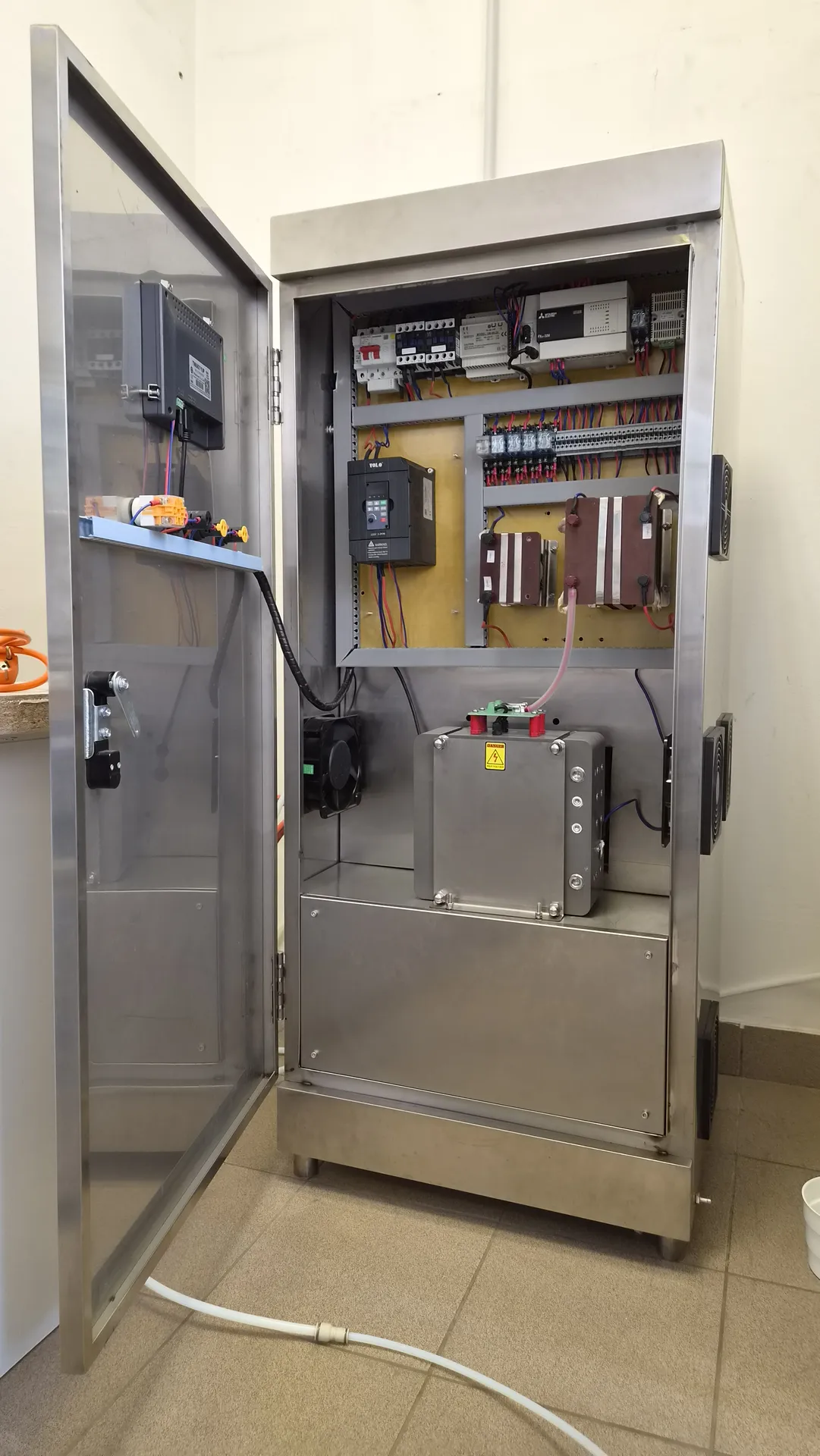
Design and Operation of an Ozone Pilot Reactor System
Ozone Wastewater Treatment – Advanced Oxidation Process for Persistent Pollutants Removal
Funded & Grant Projects
Our official projects co-financed by the European Union and national funding schemes.
Development of technology and service using industrial-scale ozone for wastewater treatment.
Project Summary
The research topic is environmental industry innovation: we aim to create a modern, sustainable wastewater treatment technology for municipal and industrial (containing hazardous micro-pollutants) wastewater using extremely high concentrations of ozone.

Implementation of Laboratory Information Management System (LIMS) at Bálint Analitika Ltd.
Project Summary
The aim of the investment is the complete digitalization of workflows from sample receipt to result issuance by introducing an ERP/LIMS system. This significantly increases internal synergy, reduces costs, and speeds up customer service.
Research of a new plant conditioner to reduce toxin production in cereals, other plants, and detoxification of food raw materials and animal feed using industrial-scale ozone technology
- Bálint Analitika Ltd. (consortium leader)
- University of Debrecen
- Budapest University of Technology and Economics
The contamination of bread cereals with weather-induced toxins severely affects the entire national economy, leading to the destruction of cereals. Therefore, it is a national interest to grow, produce, and sell healthy and economically loss-free plants both domestically and internationally. The project aims to develop a technology and related complex service for detoxifying infected cereals and pests, as well as preventing infections.
Currently, the procurement of capsaicin compounds on the market is a multi-million item. During the development of the appropriate synthesis, the use of expensive auxiliary materials will be minimized, avoiding unnecessary by-products, with a strong focus on selecting atom-efficient reactions, reducing energy consumption, and ensuring sustainability.
Compared to conventional cultivation technologies, the integrated plant protection technology based on the application of allelochemicals may be suitable for the introduction of advanced, higher requirement integrated plant protection systems, allowing the protection of beneficial organisms.
Unlike current market players, the service aims to provide a proactive and preventive solution to the problem. The market demand for the developed technologies (cost-effective synthetic production of capsaicin and ozone-based cereal disinfection) ensures the viability of our planned services. The issue raised in the project affects not only Hungary's food industry but is a well-known global challenge, thus the research has international significance.
The consortium leader BÁLINT ANALITIKA Ltd. is one of Hungary's largest and most renowned chemical and medical diagnostic laboratories, having participated in numerous successful research projects.
Project Results
- Phase 1 (September 1, 2021 - August 31, 2022)
- Phase 2 (September 1, 2022 - August 31, 2023)
- Phase 3 (September 1, 2023 - August 31, 2024)
Project number 2020-1.1.2-PIACI-KFI-2021-00234 was implemented with the support of the Innovation and Technology Ministry from the National Research, Development and Innovation Fund, financed by the 2020-1.1.2-PIACI KFI grant program.
Development of a method for origin determination based on the isotope ratio analysis of soils and plant species.
Project Summary
For tracking agricultural products, the production site should be indicated instead of the place of origin. The aim of the project was to research the diversity of the quantity and isotope ratios of metals, metalloids, and rare earth elements in the soils of domestic production sites.
Based on samples analyzed with ICP-MS technology, an isotope ratio database covering Hungary's production areas was created, which helps filter out products of false origin.
Danube Sediment Balance – Sustainable Sediment Management in the Danube River Basin.
Project Summary
The aim of DunaHordalék_M2 is to improve the quantity and quality of sediment in the Danube basin. The main result is the first integrated sediment management plan (ISMP) for the Danube basin.
- Advanced sediment monitoring and data management.
- Joint planning with stakeholders.
- Development of a cross-border integrated plan.